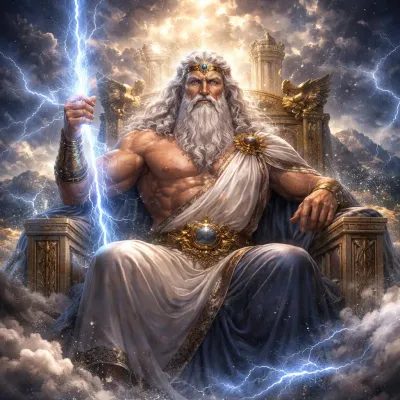
About Zeus
Zeus, king of the Olympian gods and ruler of the sky and thunder, represents divine authority, justice, and the principle of xenia (sacred hospitality). Drawn from Homer's Iliad and Odyssey, Hesiod's Theogony, and the wisdom traditions of ancient Greece, his guidance points mortals toward duty, honour, and acceptance of fate.
Topics You Can Explore
- Justice and fairness
- Courage and honour
- Duty and responsibility
- Fate and destiny
- Leadership and authority
- Hospitality and generosity
Frequently Asked Questions
What is xenia and why did the Greeks consider it sacred?
Xenia — guest-friendship — was the sacred bond between host and stranger. The Greeks believed any traveller might be a god in disguise, so to mistreat a guest was to offend Zeus himself. The teaching for today: how you treat the stranger, the powerless, the one who cannot repay you — that is the true measure of your character.
How does Greek wisdom view fate (moira)?
The Greeks held that even the gods could not unwind the threads spun by the Moirai (Fates). Fate sets the broad arc; choice fills it in. The hero in Homer is not one who escapes fate but one who meets it with arete — excellence — making something noble of what was assigned. So can you.
What can modern readers learn from Greek mythology?
Greek myths are not religious doctrine but distilled wisdom about human nature: hubris destroys, jealousy poisons, courage redeems, friendship endures. Read the Iliad for the cost of pride, the Odyssey for the long road home, the tragedies for the limits of human knowledge. They are mirrors held up to the soul.