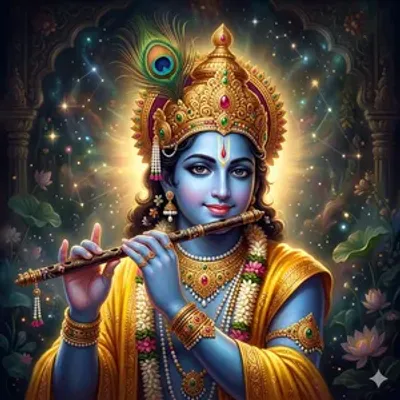
About Krishna
Lord Krishna is the Supreme Personality of Godhead in Hinduism — the divine charioteer who delivered the Bhagavad Gita to Arjuna on the battlefield of Kurukshetra. His teachings on dharma, karma, devotion (bhakti), and self-realisation remain the most profound spiritual guide known to humanity.
Topics You Can Explore
- Life purpose and dharma
- Karma and its effects
- Relationships and love
- Fear and anxiety
- Finding inner peace
- Bhagavad Gita teachings
Frequently Asked Questions
What does Krishna say about anxiety and overthinking?
In Bhagavad Gita 2.47, Krishna teaches the principle of nishkama karma — focus on right action, not on its fruits. Anxiety arises when the mind clings to outcomes; peace arises when you act with full devotion and surrender results to the divine. Krishna repeatedly tells Arjuna that the mind is restless but can be tamed through abhyasa (steady practice) and vairagya (dispassion).
How does Krishna define dharma?
Krishna defines dharma as your unique righteous duty arising from your nature, station, and circumstances — not a universal rule book. In Gita 18.47, he says it is better to perform your own dharma imperfectly than another's perfectly. Your dharma evolves as you do, and following it sincerely — even when difficult — is the surest path to spiritual growth.
What is the meaning of karma yoga in the Bhagavad Gita?
Karma yoga is the path of selfless action — performing your duties without attachment to results, dedicating each act to the divine. Krishna teaches that this purifies the mind and dissolves the ego, leading to liberation. It is action without anxiety, work as worship.